
Apricena stone or authentic Trani stone: why so little is left and how to check the quarry
Only a few still have Trani stone quarried in Trani: in 2018 the municipality had 21 authorised dimension stone quarries, registered to about 17 firms.
In short
- Only a few still have Trani stone quarried in Trani: in 2018 the municipality had 21 authorised dimension stone quarries, registered to about 17 firms.
- Legambiente Trani counts more than two hundred disused quarries in the municipality, and an authorised quarry is not necessarily in production.
- The name «Trani stone» is not protected, and stone quarried at Apricena has also been sold under that name.
- You check the provenance by asking in writing for the quarry location and the CE label with the UNI EN 12440 denomination.
Trani stone quarried in Trani is now in the hands of only a few. In the regional list of quarries, updated to 2018, the municipality of Trani has 21 authorised dimension stone quarries, registered to about 17 firms. In 2021 Legambiente Trani counted more than two hundred disused quarries in the municipality.
Many work this stone and few quarry it. The name «Trani stone» is not protected by a geographical indication, and stone quarried at Apricena, on the Gargano, has also been sold under that name. So the provenance should be asked for in writing and checked against the documents before you order.
How many stone quarries are left in Trani
The quarry list of the Servizio attività estrattive of the Regione Puglia is dated 2 March 2018. For the municipality of Trani it records 28 authorised quarries. Of these, 21 are of dimension limestone, that is stone for blocks and slabs, and 7 of limestone for aggregates.
Authorised, though, does not mean in production. The regional plan for quarrying, the PRAE, defines as active the quarries whose authorisation to work them is still valid. So the list records permits, and says nothing about the blocks extracted each year. In 2018 the dimension stone quarries at work in the municipality could have numbered 21 at most.
In the neighbouring municipalities there were fewer authorised dimension limestone quarries. Minervino Murge had 11, Ruvo di Puglia 10, Bisceglie 4, Corato 2, Andria and Barletta one each. On the Gargano, across Apricena, Poggio Imperiale and Lesina, 25 quarries were authorised, all for dimension stone.
The same list marks 7 quarries in Trani as closed and reclaimed, and leaves out those abandoned without reclamation. Legambiente's count, over two hundred, puts together the disused quarries that had an authorisation and those that never had one.
The PRAE, approved in 2010, places the Trani marble deposit among the eight areas of Puglia degraded by past quarrying. There, quarrying depends on the approval of a detailed plan. In September 2025 the Region allocated €100,000 to the Comune di Trani for that plan. In July 2026 it met the eight districts to resume the path towards the plans.
Who quarries the stone and who works it
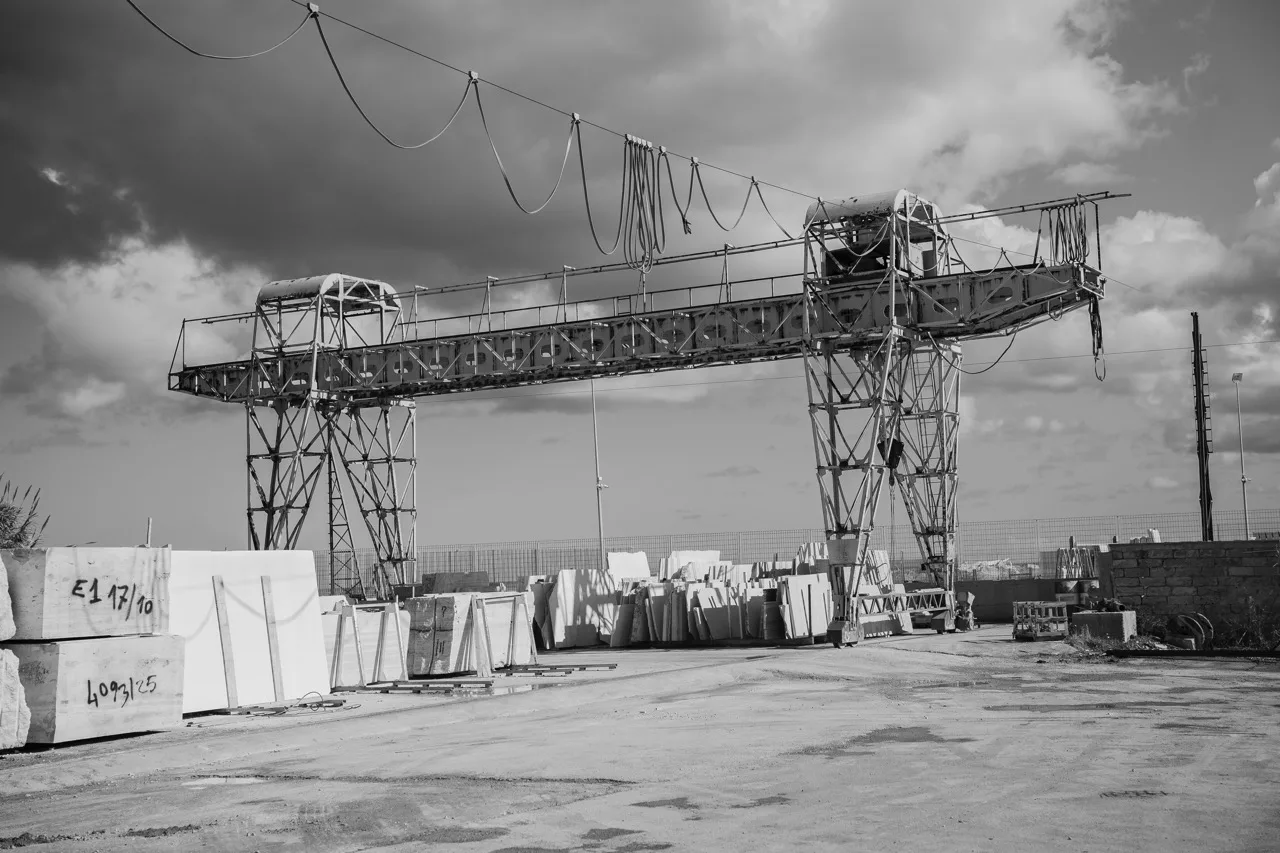
According to Legambiente and the European Eurolithos data sheet, the Trani basin was the largest limestone deposit in Puglia at least until the late 1980s. Today it counts above all for processing. About 40% of the companies in Puglia that process stone are based here.
According to Eurolithos, many interests today go beyond the quarry. They focus on processing the blocks and selling finished products.
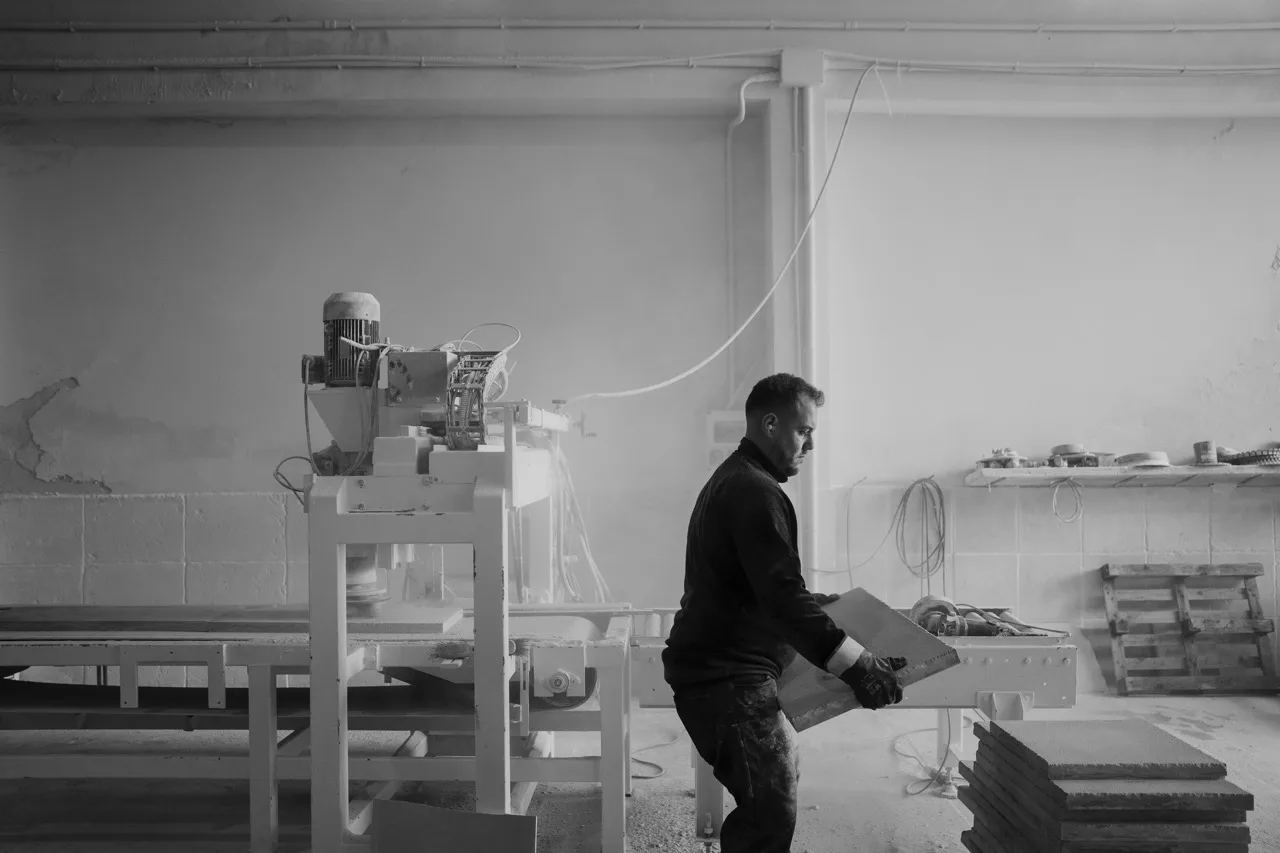
A sawmill can work blocks bought from other people's quarries. An article in the magazine Marmi Graniti Pietre reported that the rough blocks from Apricena not worked on site largely ended up in Carrara, Trani and Verona. According to the Region, 90% of the stone quarried in Puglia comes from the Apricena basin, a figure published without a reference year.
What reaches the market under the Trani name
That Apricena stone has been sold as Trani can be read in Apricena sources too. The Comune's website says that the local marbles and stones are «often circulated as trani». In February 2011 the magazine Sudest recalled that this stone, little known at first, was «even marketed under the name of Trani».
In its Rapporto cave 2014, Legambiente publishes the photo of a quarry with this caption: «Trani stone quarry site in the municipality of Apricena». The two stones are limestones from different basins and geological formations. You will find the technical comparison between them in our article on Trani stone or Apricena stone.
Variety names overlap too. According to geological sources and Apricena producers, serpeggiante and filetto rosso are varieties of the Apricena basin, like fiorito and silvabella. Yet they often appear in lists of Trani stone. The names bronzetto and biancone are used in both basins.
Since 1 December 2025, EU Regulation 2023/2411 has allowed a geographical indication to be requested for craft and industrial products too, natural stones included. The first four Italian applications approved by the Ministry, in July 2026, concern glass, lace, coral and cameo. There is no record of any registered indication for Trani stone.
What does exist is the regional mark «Pietre di Puglia», owned by the Region. Its rules require the stone to have been quarried and sawn in Puglia. So it applies to Trani just as to Apricena, and on its own it does not tell you which basin the slab comes from.
How to check the provenance before you buy
Provenance cannot be established with certainty by eye. Technical identification is done in a laboratory, with a petrographic examination under the EN 12407 standard.
So before you order, it is the documents that count. The UNI EN 12440 standard, in force since 14 December 2017, sets the criteria for naming natural stones. The name is made up of traditional name, petrographic family, typical colour and place of origin. The CE mark of a stone quarried in Europe must show this denomination and the manufacturer.
The European Construction Products Regulation 2024/3110, applied from 8 January 2026, keeps CE marking and the manufacturer's declaration. You can ask the supplier for these documents in writing.
- The declaration of performance and the CE label, with the full denomination and the place of origin.
- The quarry, or at least the extraction locality, to compare with the regional list of quarries.
- Test reports made out to the same denomination as the stone you are buying.
- The delivery note, with the same denomination written in the quote.
- A sample from the batch and, if you can, a visit to the sawmill to see the blocks.
The British Stone Federation recommends that every sample state the traditional name, quarry locality, country of origin and petrographic family. If the supplier cannot or will not give this information, it advises choosing another stone.
The declared provenance also carries legal weight. Article 515 of the Criminal Code concerns delivering to the buyer something different from what was declared or agreed «in origin, provenance, quality or quantity».
Why provenance matters on site
Later batches of stone never have exactly the same tone. That is why the material for a floor should be ordered all in one go, with a few spare slabs from the same batch.
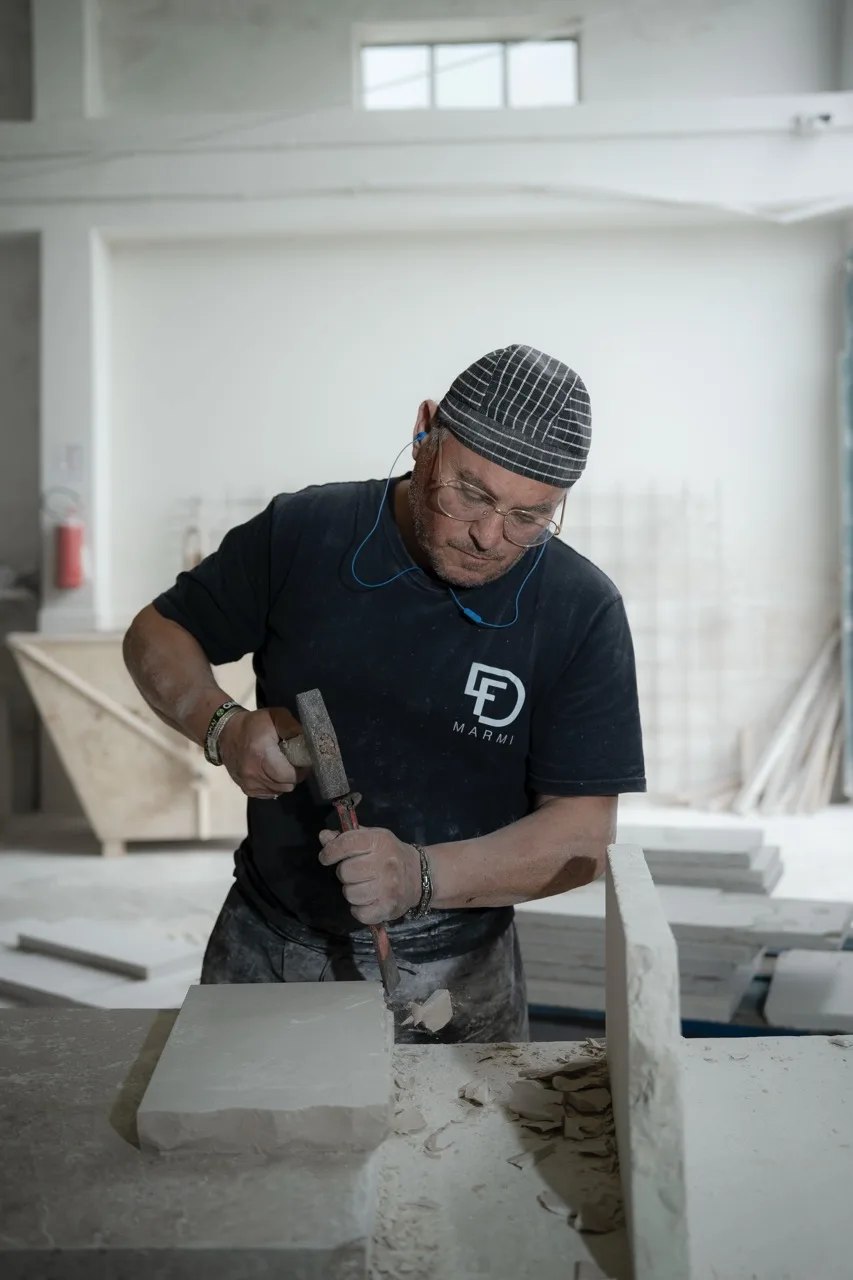
We are among the few who still quarry it. We quarry Trani stone from our own quarry in Trani and have been working it in our own sawmill since 1994. Buying from the producer means the batch stays the same from the start of the job to the end, and special pieces such as thresholds, steps and window sills come out of the same blocks as the floor.
Provenance weighs even more when new stone goes next to stone already laid. For the historic buildings in the L'Aquila earthquake crater, the guidelines of the Ministero della Cultura apply. To rebuild elements such as cornices, they call for materials similar to the originals «in size, shape, composition, colour». The 1964 Venice Charter adds that new parts must blend into the whole and be distinguishable from the originals.
At home the same happens on a smaller scale. If you extend an old Trani stone floor into a new room, compare the sample with the slabs already laid and with the light in that room.
For streets and squares, Trani's 2019 building regulations call for attention to traditional materials. As a secondary option, in contemporary settings, they allow «materials of the Apulian tradition» such as travertines, Trani stone, Apricena, pietra serena and lava stone. Provenance therefore stays the client's choice, and it is worth writing its locality into the specifications.
Frequently asked questions
In which localities are the Trani quarries?
In the 2018 regional list, the municipality's authorised dimension stone quarries are in localities such as Sant'Elena, Casa Rossa, Santa Lucia, Carracca and Pontelama. Fondola, Lamamare, Ponzomirro, Sant'Angelo and Santa Perpetua appear too. Among the closed and reclaimed quarries are Ponte Lama, Montericco, Casamassima and Gesù Maria.
Does a Trani sawmill only work stone quarried in Trani?
Not necessarily, because a sawmill can also buy blocks from other basins. The extraction locality of your batch should be written on the documents, from the quote to the delivery note.
Does stone quarried in Trani cost more than Apricena stone?
Public sources show no consistent price difference between the two stones. The price depends on selection, finish, thickness and size, and on its own says nothing about provenance.
Keep reading
How Trani stone differs from Apricena stone
Trani stone is quarried in the northern Murge, in the Calcare di Bari, and Apricena stone in the western Gargano. Biancone and bronzetto are names used in both basins.

Trani stone: from the quarry to the finished work, the 10 stages of processing
Diamond wire in the quarry, single-blade saws in the sawmill, water jet for bespoke pieces: ten stages told one by one, from block to laying.
From theory to your site
If you are choosing stone for a project, we'll help you work out which finish really holds up.