
What colour Trani stone is, from biancone to beige
Where the pale colour of Trani stone comes from, how much the finish shifts it and why the stone looks darker when it is wet.
In short
- The ground ranges from warm white to ivory and beige, with a few brown veins.
- Biancone is the palest layer in the quarry, described sometimes as warm white and sometimes as beige.
- Rough surfaces and antiquing make the stone paler, while polishing and brushing make the tone livelier.
- Later batches never have the same tone, so you choose by looking at several real slabs.
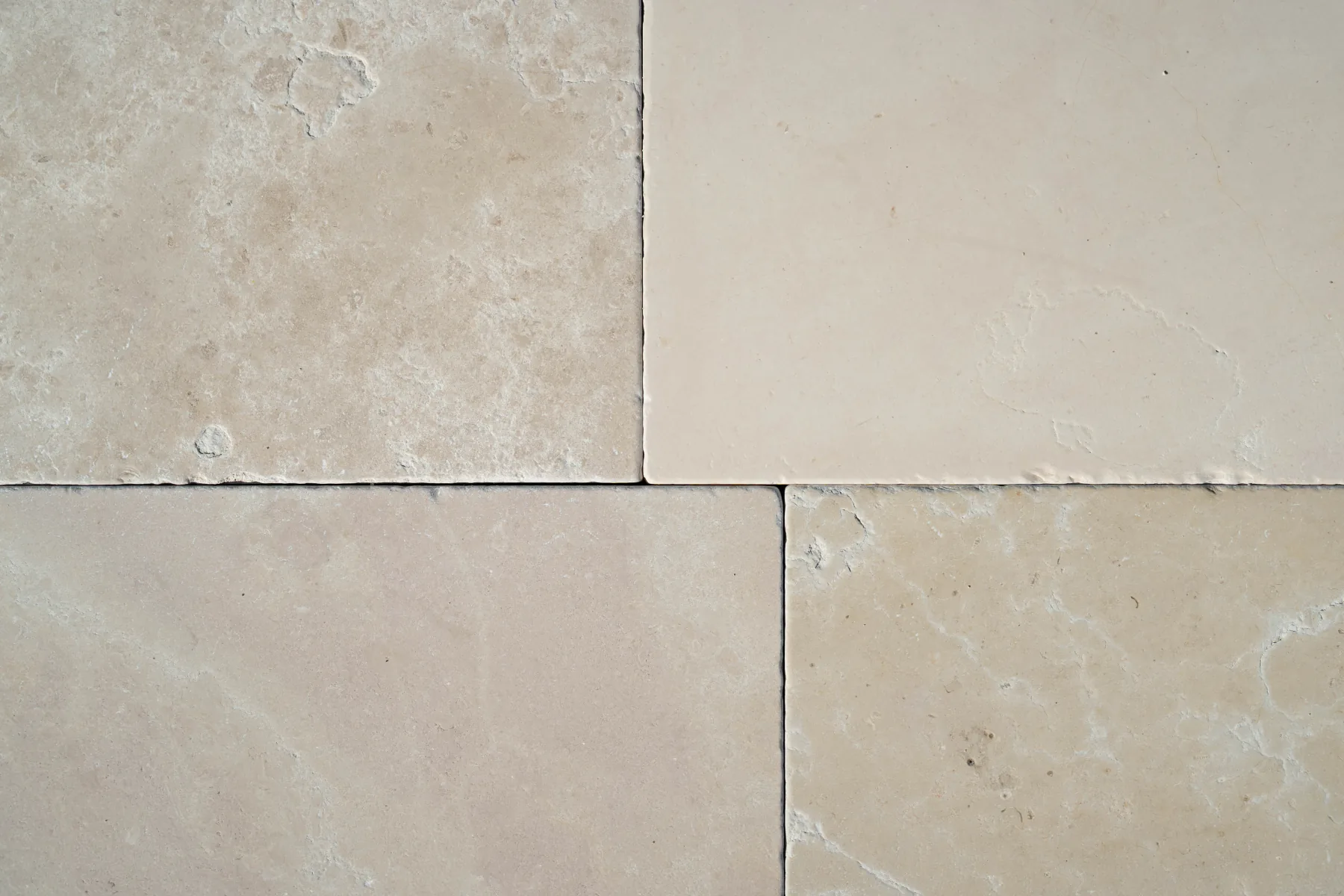
Trani stone is pale: the ground ranges from warm white to ivory and beige, with yellow or faintly pinkish shades and a few brown veins. In producers' technical data sheets the reference colour is Havana beige. The palest and most uniform selection is biancone.
There are stronger tones too, from the red of some layers to a darker, bituminous variety. Then the working counts: the same slab looks paler bush-hammered, and brushed it has a livelier colour. Wet, on the other hand, it darkens.
Where the colour comes from
Compact limestones often take their colour from the foreign substances they contain, and Trani stone contains few. In the technical data sheet of a Trani producer, calcium carbonate is 98.6% and iron oxide 0.2%.
In a study of the mosaics in the baptistery of San Pietro in Canosa, iron turns out to be the main cause of the red and brown tones. The stone tesserae in those colours contain a lot of it, while those from ivory white to grey are calcite with a little quartz. The study does not concern Trani stone, so the finding is only a general pointer for limestones.
Technical data sheets describe Trani stone as having stylolites, thin zigzag lines found in carbonate rocks. They form through compaction and dissolution as the sediment turns into rock, and along the line a film of clays, iron oxides and organic matter is left behind.
The limestones quarried around Trani belong to the Calcare di Bari, a sequence of Cretaceous limestones about 2000 metres thick. The colour changes from one layer to the next, and quarrymen give names to the layers, which they call «mani», hands. In the Gesù Maria district, for example, they distinguish bronzetto, venato rosso and patanoso.
Biancone
In Trani, biancone is the name for a layer of white limestone, paler and more compact than the ones around it. In 2001 Baldassarre, Iannone and Moresi devoted a study to how consistent its quality is across the Trani basin. A biancone is also quarried at Apricena, so the name alone does not tell you which basin a slab comes from.
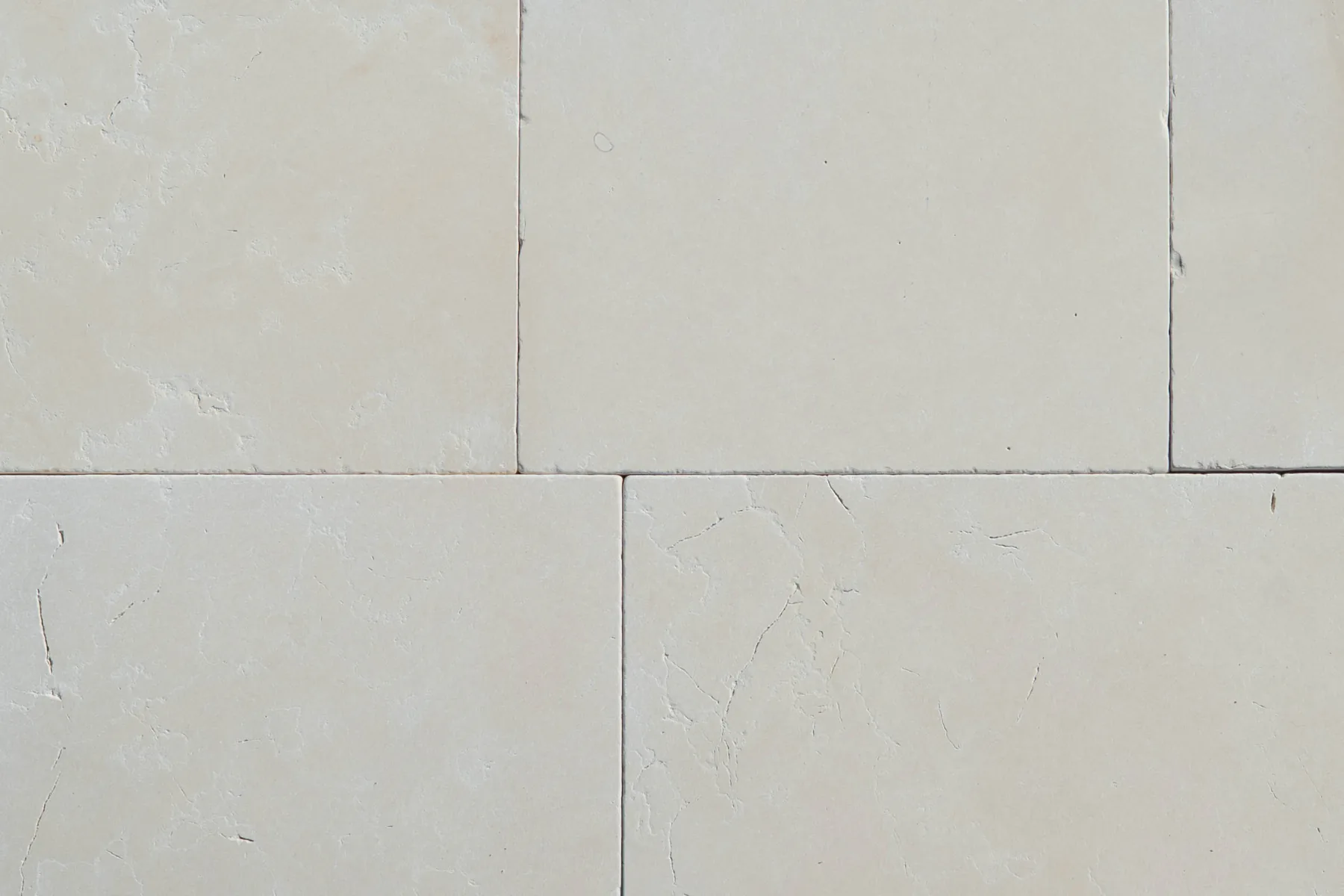
One dealer describes it as a warm white, far from the cold white of many marbles. A material data sheet instead classifies it as beige, very uniform in colour. Neither description rests on a measurement of colour.
Our most uniform selection is extra biancone marble. We set aside the slabs with marked veining, keep only those of constant colour and give them a saw-cut honed finish. This finish closes the pores without taking the stone to a mirror shine.
The range that comes out of the quarries
Descriptions by Trani producers name white, off white, ivory, beige, warm yellow, pinkish, reddish and pale greyish. Red Trani scorza runs from brick red to dusty pink. In the Lamadoro district a darker, bituminous material is quarried, not well suited to fine work, and used mainly for plinths and paving.
| Tone | How it looks | Some of our stones in that tone |
|---|---|---|
| White | Pale, constant ground, little veining | Extra biancone marble, uniform white Trani marble, sandblasted Trani marble, white Trani chianca, Cream Sablè |
| Ivory | Pale slabs in tones that differ from one another, from ivory to warm white | Shade-varied white marble |
| Beige and golden | Warm ground, with a tone that can vary from piece to piece | Classic Trani chianca, brushed Trani marble, Beige classico, Beige antico, Noisette antico |
| Warm and varied | Warm tones, dark veins, changes of tone and small natural voids | Rustic Trani marble |
Beige classico, Beige antico, Noisette antico and Cream Sablè are names from our line, and other producers have their own names for similar selections. «Trani stone» too covers a basin wider than the town, reaching towards Andria, Barletta, Bisceglie, Corato and Ruvo di Puglia.
Some dealers list serpeggiante and filetto rosso among the Trani varieties, but geological sources and Apricena producers give them as varieties of Apricena, in the province of Foggia. Bronzetto, on the other hand, is a name used in both basins.
How the finish shifts the tone
A rough surface scatters light differently, and the colour tends to look paler than on the same stone honed. For bush-hammering, a data sheet on finishes also notes that colour differences between slabs are strongly toned down. Our sandblasted stone, for example, stays pale in the sun.
Antiquing by tumbling goes the same way: it lightens the stone and takes it towards a fairly even cream colour. Brushing leaves a slight orange peel texture and also brings the colour back to life. On our brushed Trani marble the golden tones come to the fore.
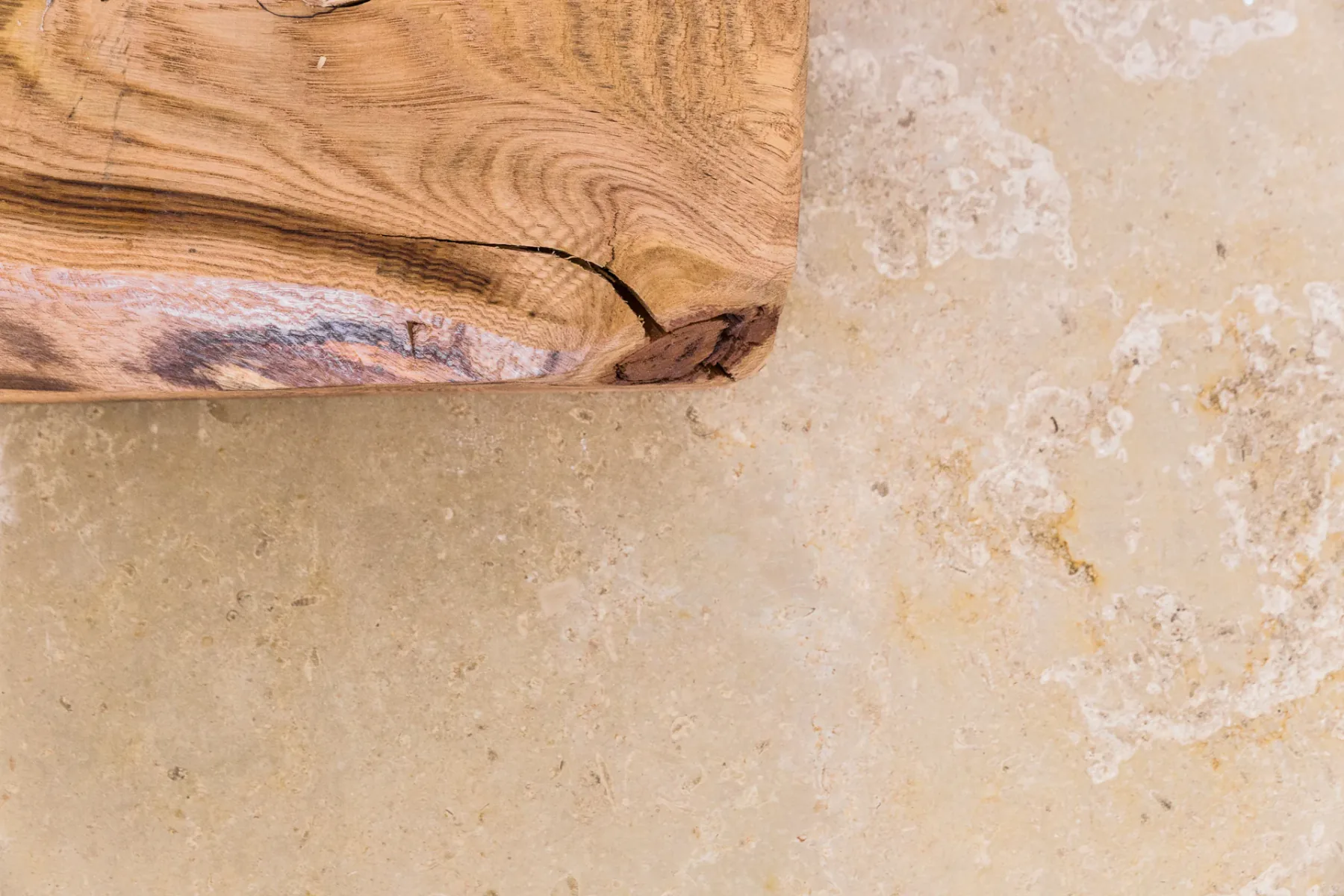
Polishing saturates the colours, making whites brighter and dark tones deeper. In honing the tone becomes livelier as the abrasive gets finer, while a short pass leaves the stone paler. Honed and polished, though, remain indoor finishes, because outdoors they turn slippery.
For the palest possible white, then, go for a matt surface, sandblasted or bush-hammered. For an interior that needs to feel warm, we recommend brushed.
How the colour changes with water and over the years
Wet, Trani stone looks darker and its colour deepens. Water fills the pores of the surface, which then scatters less light than when it is dry. The difference shows more on a rough finish than on a polished one.
Some treatments fix the wet look, others are designed to leave the colour natural. Colour enhancers go on surfaces that are not polished, the effect builds with each coat, and over time they need reapplying. For the waterborne stain protector the maintenance sheet asks for a test, to check whether the colour changes.
Vinegar and descalers dull limestone and change the look of the surface they touch. For everyday cleaning, water and a neutral detergent are enough.
Over the years foot traffic counts too. Where people walk most, the classic chianca darkens a little, and brushed marble, which is for indoors, tends to polish up. Sandblasted stone, by contrast, does not polish up.
Choosing the tone on real slabs
Indoors, Trani stone changes colour with the daylight, and every slab has its own veining. That is why a 10 cm sample is not enough: you need several slabs, looked at in the light of the room they are going into.
Later batches never have exactly the same tone. With a uniform selection the space looks bigger, but a slab replaced years later shows. With shade-varied stone the difference between pieces is there by design, and a new piece goes unnoticed.
Think about stains too: they show sooner on the palest selection, and in a kitchen they weigh on the choice of tone. When you buy straight from the sawmill, the batch stays the same for the whole job, and thresholds, steps and window sills come from the same blocks as the floor.
Frequently asked questions
Does white Trani stone cost more than beige?
It depends on the selection more than on the colour. Biancone in slabs is the most expensive item, from €120 to €160 per m², because the bed yields little of it. Uniform white Trani marble, on the other hand, sits in the range of split antiqued stone, from €30 to €45 per m², like the brushed and the rustic. Among the chianche the white costs more than the classic, even though only one range is published, from €80 to €110 per m².
Which tone should I choose for a poolside?
A pale tone is better: it reflects the light and you can still walk on it barefoot at midday. Among our stones, sandblasted Trani marble works well, and so does white Trani chianca, worked by hand and brushed, with an open grain that holds a wet foot. The extra biancone in our catalogue is honed, so it stays indoors.
Does Trani stone yellow in the sun?
We have not found any measurements taken on Trani stone. One maintenance sheet states that its composition reduces yellowing over time, and our sandblasted stone does not yellow. Outdoors, though, especially in towns, black crusts encouraged by pollution can form on the ornamental stones of Puglia.
Keep reading
How Trani stone differs from Apricena stone
Trani stone is quarried in the northern Murge, in the Calcare di Bari, and Apricena stone in the western Gargano. Biancone and bronzetto are names used in both basins.

Trani marble or Trani stone? Six confusions behind a famous name
Geologically it is a compact limestone, not a metamorphic marble. But the name has held for centuries: here is where it comes from, what really changes and what it costs.
From theory to your site
If you are choosing stone for a project, we'll help you work out which finish really holds up.