
The drawbacks of Trani stone and how to deal with them
Acids dull it and sand scratches it, but on our stone frost takes away less than 2% of its strength. Where the limits come from and how to deal with them.
In short
- Household acids dissolve the calcium carbonate and leave a dull mark that does not wash off.
- The protective treatment slows down oil stains but does not stop acids.
- Where the stone gets wet you need finishes with grip, such as bush-hammered or sandblasted.
- On our stone, after frost cycles, the breaking load drops from 1922 to 1890 kg/cm², less than 2%.
Almost all the limits of Trani stone come from its chemistry, because it is a limestone made of about 98% calcium carbonate. Household acids dull it for good, oil stains it if the surface is not protected, and sand under shoes scratches it. Polished and wet it becomes slippery, and the tone changes from one batch to the next.
It takes in very little water, though, and that is what lets it stand up to frost. On our stone, frost cycles take less than 2% off its compressive strength. Most of the drawbacks can be managed by choosing the right finish for each place and protecting the stone where oil gets spilled.
Acids leave a mark that will not come off
When an acid touches the stone it dissolves the calcium carbonate on the surface, with the fizzing typical of calcite. Vinegar, lemon, descalers and bathroom cleaners all do this. On a polished or honed finish it leaves a dull area that no cleaner will remove.
To bring it back you need a stone professional, who hones or polishes the area again. In a kitchen, lemon and vinegar often end up on the worktop, so it is a limit to take into account when you choose the surface.
A protective treatment slows down oil stains and does not stop acids. It works inside the pores against absorption, while an acid reacts on the face of the stone the moment it touches it. The same goes for marble, which is also made of calcite.
Oil gets in even when water stays out
The stone we work has a water absorption coefficient of 0.300%, and in other producers' data sheets water absorption still stays below 1%. Oil and grease get in all the same, if the surface is not protected. An oil stain darkens the stone and usually has to be dissolved chemically, so that it can then be rinsed away.
That is why, in the kitchen and dining area, the treatment that repels water and oil should be in the quote from the start. On extra biancone, our palest selection, stains show sooner, and there the treatment is not optional.
Why sand scratches it
On the Mohs scale calcite has a hardness of 3 and quartz 7, and each mineral scratches the ones below it. Sand is made mostly of quartz and feldspars, so the sand that comes into the house under your shoes works on the floor like an abrasive. Even a steel blade, which sits just above 5 on the scale, leaves a mark.
On this point marble and Trani stone are equal, because both are calcite. Finishes that already have a texture, such as antique and rustic, hide new scratches within the surface. A brushed finish, on the other hand, takes on a slight shine where people walk most. Deep scratches and small chips have to be repaired by a professional, who then polishes the area again.
When the stone gets slippery
Slipperiness depends on the finish, so it is measured on the finished product with the pendulum test of UNI EN 14231. For outdoor paving, the product standards set 35 in wet conditions as the safety limit. A face with a roughness above 2 mm is considered not slippery even without a test.
Honed or polished, Trani stone becomes slippery outdoors, which is why we only use these finishes indoors. Around a pool we recommend bush-hammered, sandblasted or antiqued. A shower tray needs a finish with grip, sandblasted or lightly bush-hammered.
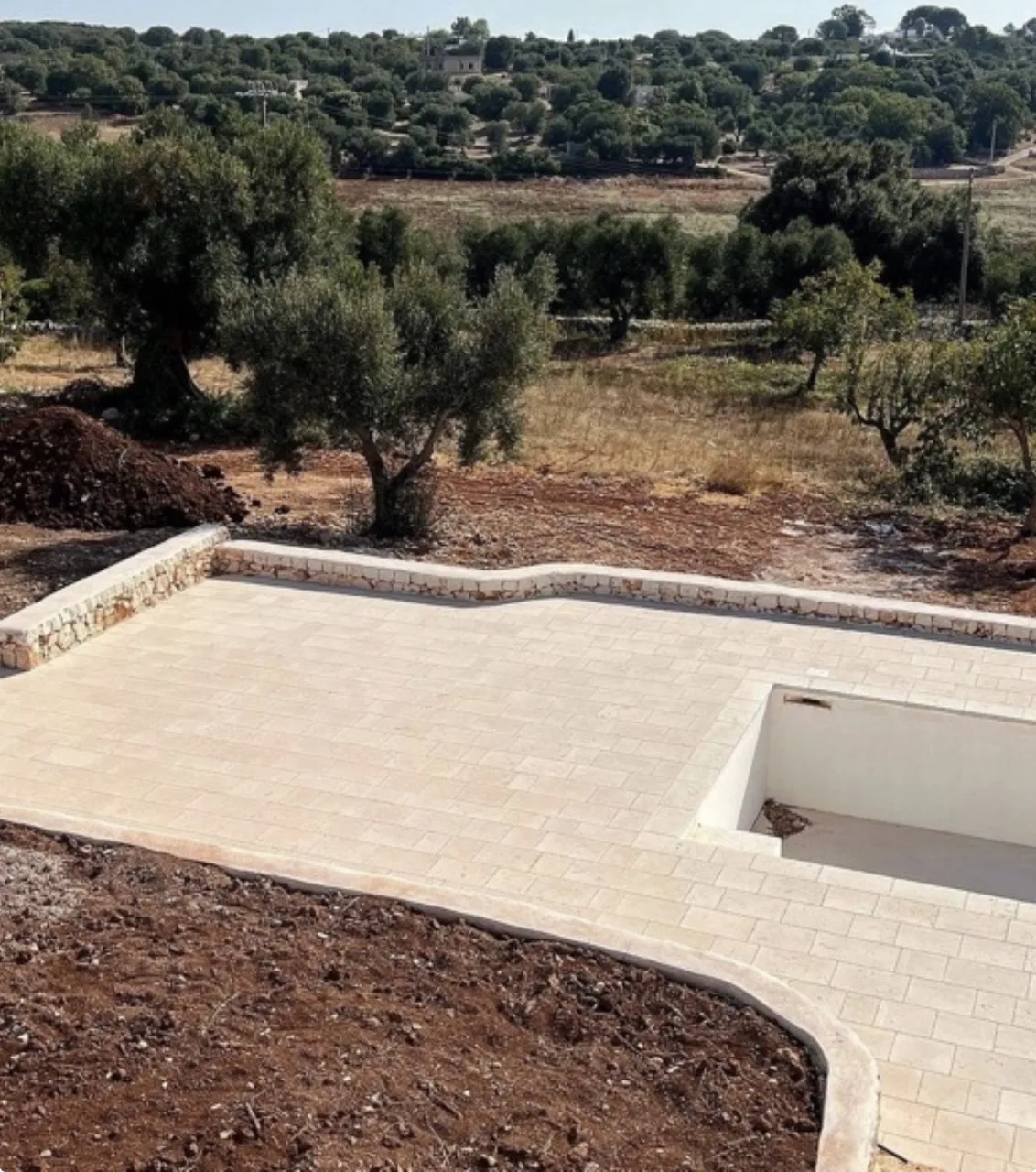
DM 236/89 on architectural barriers requires a friction coefficient above 0.40, both dry and wet. It also says that polishing and protective coatings must not change it. Outdoors a polished finish has a second limit, because with rain and direct sun it loses its mirror shine within a few years.
Stains that do not come from the stone
Many stains blamed on the stone actually come from the substrate or from what is placed on it. Recognising them keeps you from making them worse, because on a limestone the wrong remedy is almost always an acid.
| What you see | Where it comes from | What to do |
|---|---|---|
| Dull patch on a polished surface | An acid has dissolved the surface | Rehoning |
| Dark stain that spreads | Oil or grease on unprotected stone | Solvent or cleaner |
| Powdery white film | Salts brought up by moisture in the substrate | Vacuum, no water |
| Rust coloured mark | Wet metal or fertilisers with ferrous sulphate | Poultice |
| Blackening outdoors | Moss, algae and mould | Cleaning without acids |
The white stains are called efflorescence. Water rising from the screed carries soluble salts to the surface and leaves them there when it evaporates. They are prevented by keeping moisture under control, with an unbonded screed, waterproofing and ventilation.
Rust coloured marks often come from pots and metal furniture left wet, or from lawn fertilisers containing ferrous sulphate. When the stain has gone deep it can remain even after the poultice.
Dark lines and small voids
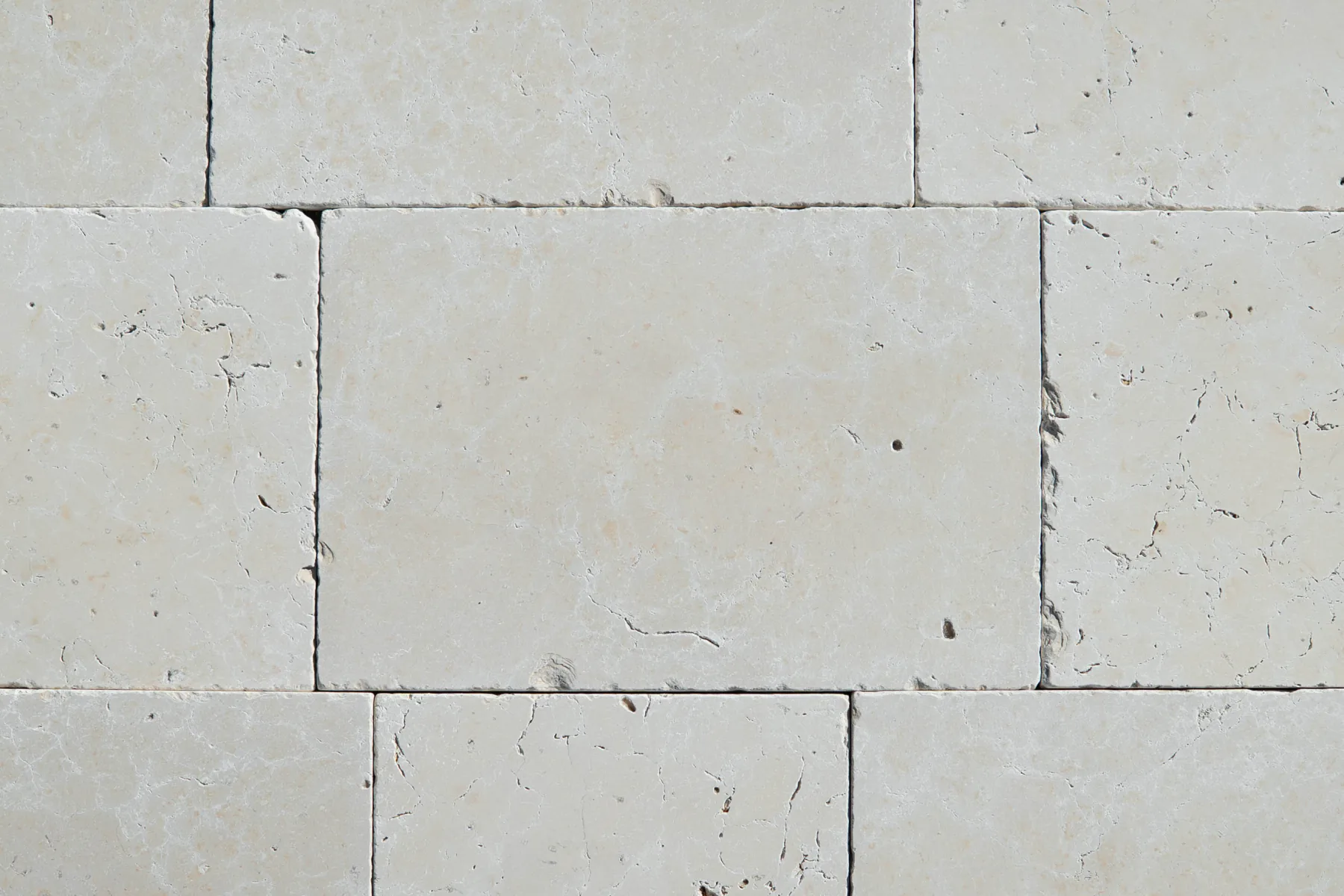
Stylolites, the dark zigzag lines, and small voids are natural marks of the stone, and how many you see depends on the selection. In the trade, voids of a few millimetres are called taroli, and they are often filled with resin mixed with dust from the same stone.
When the batch changes
Later batches never have exactly the same tone, and for CE marking the visual characteristics are checked on every lot. For mixed sizes we advise allowing 10% extra, for cutting waste and to keep a few spare slabs from the same batch. It is best to order steps and thresholds together with the floor, so the batch colour is the same.
What holds up well
The data sheets we compared all give water absorption below 1%, and the porosity stated for Trani stone is 0.2 or 0.3%. That is where its frost resistance comes from, because it is the water inside the stone that splits it when it freezes.
A stone is called frost susceptible when it loses more than 20% of its compressive strength after frost cycles. On ours the breaking load goes from 1922 to 1890 kg/cm², less than 2%, and in the data sheets of two other producers the drop is between 6 and 7%. Only one producer reports a sharper drop in flexural strength, about a quarter. For driveways and steps we cut to measure in thicknesses greater than the catalogue 1.2 cm.
Salts find little room either, because their crystals grow inside the pores. The European test for salt crystallisation, UNI EN 12370, is designed for stones with an open porosity above 5%. The porosity stated for Trani stone is less than a tenth of that threshold.
Frequently asked questions
Can it be used for a pool edge?
Yes, with a finish that gives grip when wet, such as bush-hammered, sandblasted or antiqued. The real risk is acidic water, because below pH 7 limestones can corrode on the surface.
Is it suitable for a kitchen worktop?
It can be done, as long as you know that lemon and vinegar leave a dull mark even on protected stone. The protective treatment is still worth having, because it slows down oil and grease stains.
Does it work with underfloor heating?
Yes. UNI EN 1264 requires the floor not to exceed a thermal resistance of 0.15 m²K/W, and a compact 1.2 cm slab stays well below that, even counting the adhesive. With a thermal expansion of 0.0048 mm/m·°C, it also moves very little when the system switches on and off.
How much does wall cladding weigh?
With a specific weight of 2671 kg/m³, a 1.2 cm slab weighs about 32 kg per m², against 24 for a 10 mm porcelain tile. On plasterboard or on an external insulation system that load needs checking. For stone floors, walls and ceilings the reference installation standard is UNI 11714, in its part 1, which also guides the choice of adhesive.
Keep reading
How to clean Trani stone and remove stains without damaging it
Wash it with lukewarm water and a neutral detergent, no acids. Oil, wine and rust come out with poultices and dedicated stain removers, and the protective treatment goes on once laying is finished.
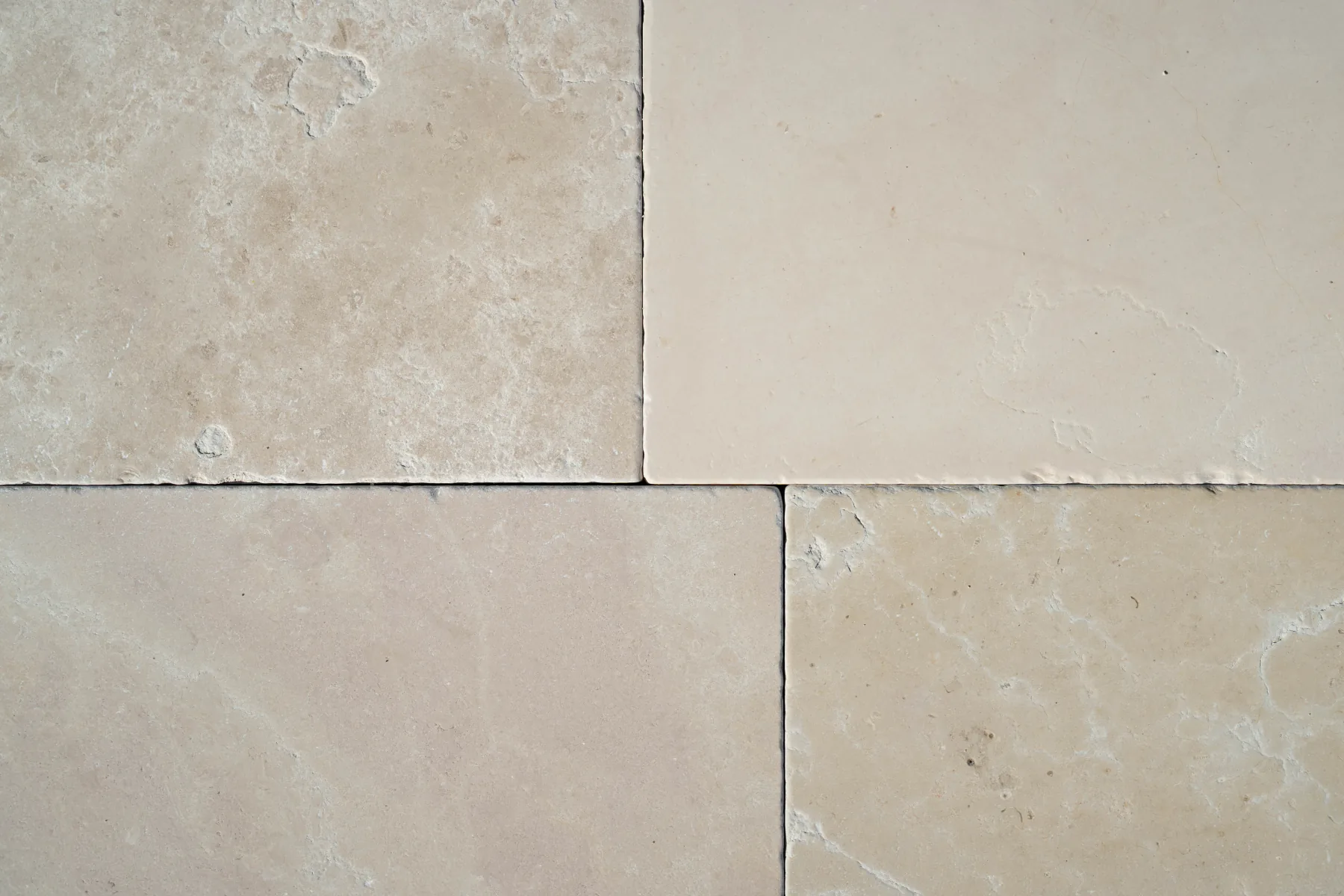
What colour Trani stone is, from biancone to beige
The ground is pale because the stone is almost entirely calcium carbonate, with just 0.2% iron oxide. Biancone is the palest selection, and the finish shifts the tone.
From theory to your site
If you are choosing stone for a project, we'll help you work out which finish really holds up.